A Room Without Mirrors
An archivist inherits a seaside house and discovers why its quiet room was built to show no reflection.
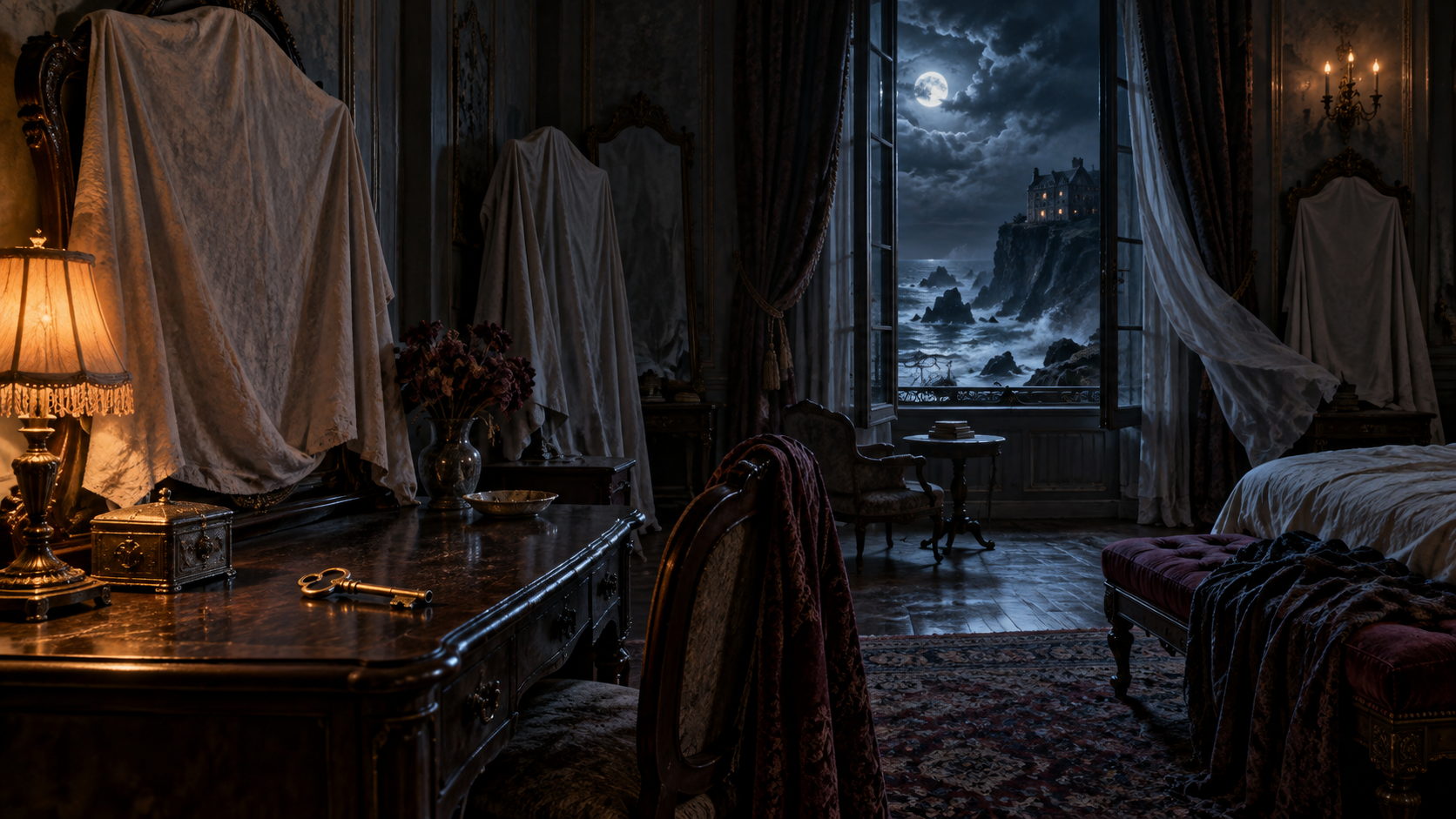
Mara Venn returned to Saltmarsh House with an archivist's gloves, a surveyor's torch, and her aunt Celia's last request. The house stood above a black cliff, its windows filmed with salt and its chimney leaning toward the sea. Mara restored damaged records for a living. She knew how to make a page readable without pretending it had never been torn. Celia had taught her that distinction, and Celia's will seemed to test it. Before any sale, Mara was to catalogue the estate. Beneath the instruction, underlined twice in the older woman's restless hand, were six words: Begin with the room without mirrors.
Mara had been forbidden to enter that room as a child. It waited at the end of a passage where the wallpaper had faded to the color of old bone. Her family called it the quiet room. They said mirrors distressed Ione, Celia's elder sister, who had died before Mara was born. Ione, they whispered, saw visitors before they arrived and took reflections for witnesses. “She had to be kept calm” was the phrase everyone used. Mara had accepted it as a child accepts a locked door: as a fact of the house rather than a choice made by people with keys.
The executor had taped a small brass key to his letter. The room beyond held a bed frame, a washstand without glass, and curtains nailed over the sea-facing window. Pale rectangles marked where mirrors had once hung, but the hooks had been removed. Along one wall, at shoulder height, small nail heads formed a line too regular to be a repair. Mara photographed them before she touched anything. When she lifted a loose piece of skirting, cold air moved over her wrist. It smelled of wet iron, salt, and a space that had been shut away from ordinary time.
Behind the skirting stood a second wall of dark timber. Mara documented the joints, measured the boards, and removed one panel only after calling the estate lawyer to note the discovery. A passage appeared, scarcely wide enough for a person to turn around. On its inner wall were four panes of one-way glass. Each pane faced the quiet room. Beneath them lay labelled recording reels, a hand-cranked machine, and notebooks wrapped in oilcloth. The room without mirrors had not been made to spare Ione reflections. It had been made so that someone could watch her while she could not see who watched.
The first reel was marked IONE, APRIL 1987. Mara logged its condition, photographed the label, and then threaded it through the machine. Celia's young voice emerged, not cruel but tight, the voice of someone reading instructions she had learned to call necessary. “Ione says the window has eyes again. Mother says we must not encourage it.” After a pause, another woman spoke, low and exhausted. “There are eyes because you made a place for them.” Mara stopped the recording and wrote down the words exactly. She did not yet know what the voices proved, but she knew the house had lied about what Ione saw.
The next tapes were worse for being ordinary. They recorded trays delivered to the quiet room, arguments about doctors, and family meetings held close enough for Ione to hear through the glass. Her father, Dr. Venn, called the watching protection. Her mother called it discretion. Celia sometimes objected, then apologized, then read aloud the note her parents handed her. The dates put Ione in her thirties. She asked that the curtains be opened, that a solicitor be called, and that someone tell Mara one day that she had not been dangerous. Mara listened until the sea changed pitch below the cliff.
In a locked tin she found Ione's diaries. Some entries were precise accounts of meals, weather, medicines, and voices in the corridor. Others described a woman moving inside the window at dusk. Mara recognized the explanation the family had used against her: Ione saw impossible things. But the one-way glass faced a narrow passage where a nurse or relative could have stood. Ione had glimpsed movement in reflection and chosen an impossible explanation because the possible explanation had been designed to be invisible. The diaries did not diagnose her. They recorded what a person did when the people around her denied the architecture of her fear.
Celia's last notebook supplied what no one had said aloud. In 1991, Ione collapsed after receiving a sedative during an argument. The death certificate said cardiac event. Celia had copied a later letter from a nurse who had begged Dr. Venn to call emergency services sooner. No report had been filed; the nurse left Saltmarsh within the month. Celia wrote that she had been nineteen, frightened of her father, and slow to understand that obedience could become participation. She could not restore Ione's life, she wrote, but she could refuse the family a clean story about it.
Mara wanted to call the discovery proof and let the word close every gap. Her work stopped her. A recording could be incomplete; a diary could be wrong in one place and exact in another; a copied letter required an original or a witness. She made a table with columns for date, speaker, physical object, claim, and corroboration. Then she called Anil Rao, an independent conservator who had once caught Mara overstating a water stain as a missing signature. Together they sealed the originals, made preservation images, and recorded an unbroken chain of custody.
Anil refused to tell Mara that the material solved Ione's death. He told her what it could support: covert observation, confinement by circumstance, medication records needing scrutiny, and a death insufficiently explained by the papers in the house. His restraint infuriated her until she understood that certainty borrowed from grief could erase Ione again, this time under Mara's preferred version. They sent copies to the county archive and asked a medical-records historian which documents could be requested lawfully. Mara did not break into a hospital basement or make a television accusation. She learned that care for the dead could require patience with the living record.
Word of the inventory reached Grant Pell, the developer who held an option to buy Saltmarsh House. He arrived in an immaculate raincoat, spoke regretfully of family pain, and offered to buy the notebooks as private materials. Old recordings could mislead, he said; the house had enough bad stories already. Mara said he was right about the recordings and wrong about ownership. They would not be sold. That night, while rain scratched the shutters, someone forced the passage door and set a box of reels on fire. Damp air killed the flames quickly, but two labels blackened beyond reading.
The break-in made every old fear feel plausible. Before the alarm sounded, Mara heard a woman's step in the corridor. In the newly uncurtained window, she thought she saw a pale figure where nobody stood outside. Yet a muddy boot print led from the service gate to the passage, and a neighbour had photographed the van of Pell's contractor on the road. Mara gave police the print, the photograph, the damaged lock, and the inventory timestamps. She did not offer the pale figure. A fact did not become less precious because something frightening accompanied it. It became more necessary to separate the provable from the felt.
The police established that Pell's contractor had entered without permission, and the purchase option collapsed. They could not promise a prosecution for Ione's death: decades had passed, Dr. Venn was dead, and the medical record was incomplete. The county archive accepted Celia's collection with a finding aid that named each source, each gap, and each unverified recollection. A disability-rights historian helped Mara write a public note about family control and isolation. They named documented harm without turning Ione into a warning, a diagnosis, or a ghost-story clue.
Celia's letters made Ione larger than the quiet room. She loved sea charts, bad detective novels, and the stubborn green of glass bottles after storms. The niece of the vanished nurse brought a postcard written in Ione's hand: I am still here. It was a small document, almost unbearably so. Mara placed it beside the death certificate, not as a dramatic key but as an answer to the records that reduced a living woman to a condition. The archive catalogue described the postcard's provenance, its limits, and its date. It also let Ione's own sentence remain plain.
The public work was slower than Mara expected. Letters arrived from people who recognized a parent, a sibling, or themselves in the language of protection. Mara replied only from the evidence, explaining that the collection did not diagnose Ione or settle every private memory. A newspaper asked for a headline about a cursed inheritance. Mara declined until the editor agreed to print the archive reference and the historian's context beside the story. Accuracy, she learned, was not a smaller form of care. It was the kind that remained when a room was empty and nobody was watching.
For months Mara slept in Saltmarsh House, though sleep never deepened there. She found no hidden body, no secret portrait, and no final confession that arranged the past into a tolerable shape. She found procedures, omissions, frightened people, and choices made easier by closed doors. Some nights sea-light moved across the window and made her reflection waver. She could not say whether the sound at the end of the corridor was pipes or a woman turning away. She stopped asking that uncertainty to answer for everything else. The mystery belonged at the edge, not at the center where Ione's life should be.
When the archive exhibition opened, the room without mirrors was not rebuilt as a spectacle. Mara removed the one-way panes, documented their position, and left a plain wall. She opened the curtains and repaired the window with clear glass. Catalogued copies were available in the library downstairs, with a content note and a way for others to add contextual records. Upstairs, the former quiet room held a chair, a lamp, and a shelf of Ione's favourite novels. Nothing watched from the walls. Nothing was made to perform. The ordinary space was not a metaphor; it was a practical refusal of the old arrangement.
Before transferring the house to a community trust, Mara invited the neighbour who had taken the van photograph to see the changed room. The woman stood in the doorway and said she had thought the house was merely cruel in an old-fashioned way. Mara answered that cruelty often depended on ordinary people agreeing not to look. Together they opened the window. Sea air came in without ceremony, smelling of kelp and rain, and the sound of children on the public path rose from below. It did not heal the past. It was simply air that no one had the right to ration.
On the final evening, Mara stood by the window while the tide lifted beneath the cliff. The glass reflected only her faint outline beside the lamp. For one moment another shape seemed to stand behind her, taller and still. Mara did not turn quickly. She opened the door instead, let corridor light enter, and said Ione's name once. Then she went downstairs to file the final accession record. Saltmarsh House kept its weather, its shadows, and perhaps its ghosts. But it no longer kept a room designed to make one person disappear.