The Last Train to Larkspur
A ticket with her mother’s handwriting leads Mara to a station that should not exist.
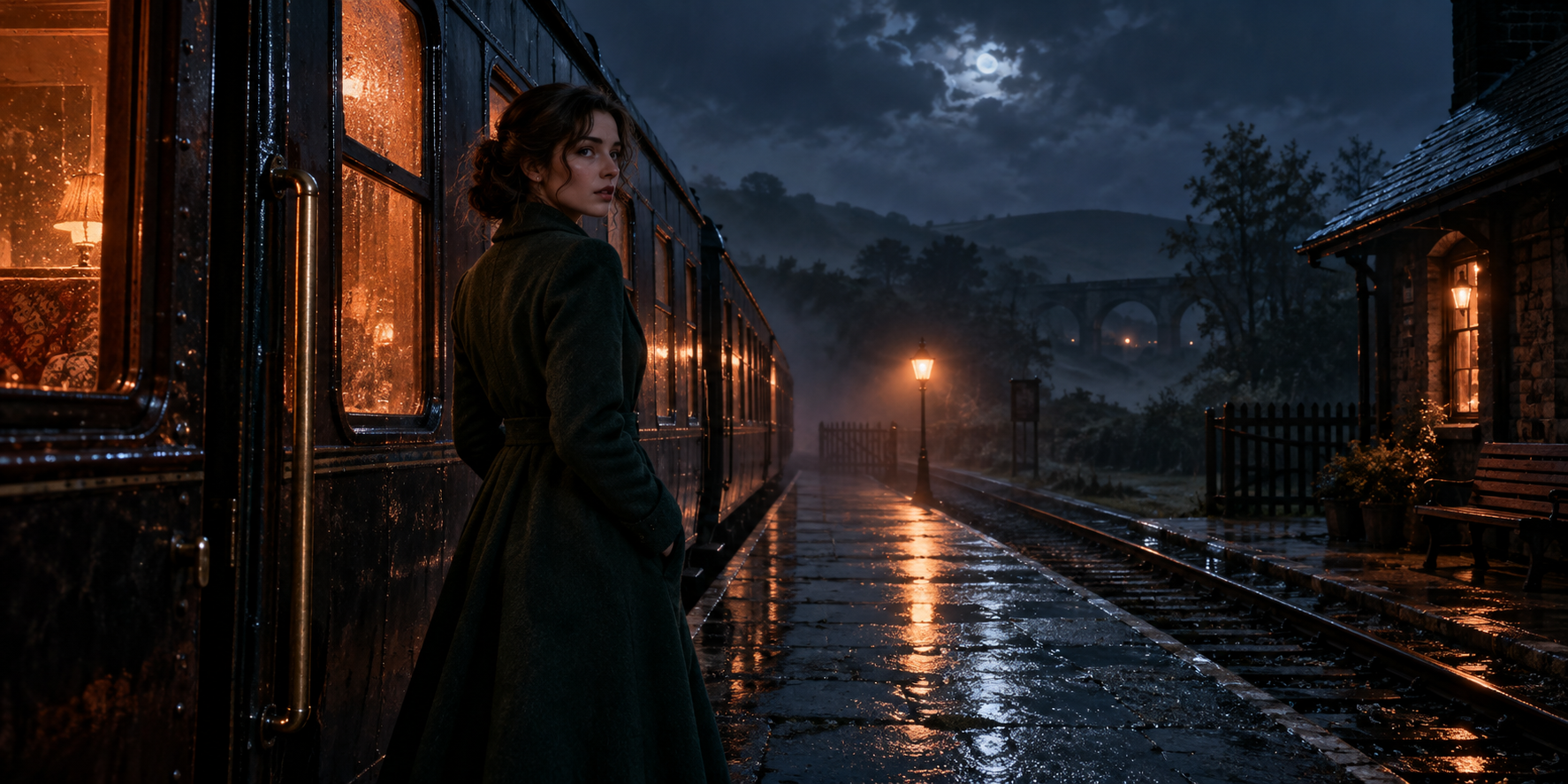
Mara found the ticket while sorting the things she had promised herself she would sort before winter. Her mother’s old coat lay across the kitchen chair, its wool gone flat at the cuffs, its cedar smell faint but unmistakable. When Mara lifted it, something clicked inside the lining. She opened the loose seam with her smallest scissors and drew out a square of card folded four times. The ticket read LARKSPUR, 11:47 PM. The branch line had been abandoned before Mara was born. Her mother had been dead for eleven years. Yet the ink beneath the destination was fresh blue, and it formed a sentence in her mother’s measured hand: Do not let him leave alone.
For an hour Mara sat with the ticket in her palm and tried to make it ordinary. Perhaps it had been tucked away years ago. Perhaps the note was some old warning, meant for a man she did not remember. Then the name Larkspur brought back the smell of wet river stones, a porch light shivering in rain, and Elias Vale standing at the end of their street with a suitcase in his hand. He had been seventeen then, angry and grief-struck and impossible to reach. She had been seventeen too, certain that love meant refusing to let someone walk away. By morning he was gone, and all she ever heard was that he had left town.
The old Larkspur station waited beyond the last row of warehouses, half hidden by weeds and alder. Mara had passed it often without really seeing it: a brick shell with boarded windows, a clock face stopped at 3:12. On this November night the boards were gone. Rain polished the platform stones. The clock hands trembled, then moved toward 11:46. Mara stood beneath the rusted canopy with her mother’s ticket in one pocket and her phone uselessly dark in the other. The air smelled not of diesel but of cold iron and crushed lilac, as if summer had been pressed into the storm.
At 11:46, a train entered the station without sound. No bell announced it, no wheel screamed on the wet rails. It simply arrived, black and old-fashioned, its windows glowing the color of lamplight behind curtains. In the last carriage doorway stood Elias. He was older, his dark hair cut short, rain running from his collar. In one hand he held the same dented brown suitcase Mara remembered from the night he vanished. For a breath neither of them moved. Then he looked at her ticket, and his face closed with the tired recognition of someone who has been expecting a punishment.
“You got one too,” he said. His voice had deepened, but not enough to erase the boy she had known. He showed her his ticket. Its destination was also Larkspur. On the back, in handwriting Mara did not recognize, were four words: COME BEFORE THE WATER RISES. Elias said the note was signed by his older brother, Thomas, who had drowned in the river that summer. “I found it in a book I bought yesterday,” he said. “A book Thomas used to steal from the library and return late.” He laughed once, without humor. “I thought I was losing my mind.”
Mara wanted to tell him he had lost the right to arrive with ghosts after disappearing from her life. Instead she stepped into the carriage. The door shut behind them with a soft, final click. The interior was almost empty: green velvet seats, brass racks, lamps that did not sway. A conductor in a charcoal uniform waited at the far end. His face seemed plain until Mara tried to remember it; then it became only the impression of a face, as if rain had blurred a photograph. He took their tickets with gloved fingers and punched each one once.
“One journey,” the conductor said. “One memory will open at each stop. You may watch. At the final stop, the passenger named by the ticket may enter the memory and keep it changed.” Elias asked what happened if he did. The conductor inspected the tiny circles punched through the card. “A saved memory requires a life to make room for it. Nothing returns unchanged.” Mara asked whether they could get off whenever they wished. “You may leave at a stop,” he said, “but not into a future you have not paid for.” Then he handed back the tickets and walked away.
The train moved. Outside the windows, Larkspur went backward. Rain climbed from puddles into clouds. The bakery that had been empty for years lit its sign, then its ovens, then its cheerful front window. A bicycle rose from a gutter and rolled backward into the hands of a laughing child. Mara saw herself at eight, racing along the pavement in a yellow raincoat while her mother called from the doorway, pretending outrage. The sight caught Mara so sharply that she gripped the seat. Her mother turned toward the train as though she could see through the glass. For one impossible second, she smiled.
Mara remembered the night behind that smile. Her mother had insisted that Mara stay home because the river was flooding. Mara had argued, wanting to meet Elias at the footbridge. Her mother had finally taken her by both shoulders and said, “Love is not proved by following someone into danger.” Mara had thought it was about a teenage fight. Now she wondered whether her mother had known more, or whether grief had taught her mother the same lesson early enough to hide this ticket for a daughter who would need it later.
Elias sat opposite her, staring at the glass. “Thomas came after me,” he said. “I had told him to leave me alone. I was furious because he knew you and I had fought. He kept saying I couldn’t walk to the river in that weather, so I shoved him.” He swallowed. “Not hard. It was nothing. Then I walked away.” He had never told Mara this. In the town’s version, Thomas had slipped while checking the flood markers. In Elias’s version, there had been an argument, a younger brother who tried to help, and an older one who believed cruelty could be taken back later.
The next window showed the riverbank under storm clouds. Their seventeen-year-old selves stood near the footbridge: Mara waiting under an umbrella; Elias shouting something she could not hear; Thomas arriving behind him, breathless and bareheaded. The scene had no sound until the conductor appeared beside their seats and touched the window with one finger. Then rain filled the carriage, loud as applause. Young Elias turned away. Thomas followed. A few moments later, the river swallowed the bank where they had been. Mara remembered waiting until midnight, angry that Elias had not come. She remembered her mother finding her soaked on the porch and saying nothing until the police lights began.
“The river stop is mine,” Elias said. “I could step off and call for help. I know where Thomas falls. I could pull him back.” His fingers had tightened around the suitcase handle. “He would live. My father would not spend twenty years drinking himself quiet. I would not leave.” The last words landed between them more heavily than the first. Mara thought of all the years she had rehearsed a reunion in which Elias apologized and explained, then of how small those rehearsals were beside a dead boy and a ruined family.
The conductor returned with a silver tray holding a small mirror. “See the fare,” he told Elias. In the mirror, a different life opened. Thomas stood alive at a crowded kitchen table, older and broad-shouldered, teasing Elias about the burnt toast. Their father laughed. On the refrigerator was a photograph of Mara, but she was not with them. She appeared in the background of a school reunion, unfamiliar to Elias, smiling politely at a man beside her. The mirror shifted again. Mara saw herself in that life, walking through the station tonight and passing a stranger with Elias’s face. She would have no memory of their first kiss in the greenhouse, no memory of the letter she had written after he vanished, no memory of ever waiting for him.
“Why her?” Mara asked, though she already understood the shape of the answer. The conductor’s gaze did not settle on her. “The changed memory removes the road that led him to her. Their love is not a possession to carry across the alteration.” Elias looked away from the mirror. He said he could bear forgetting, if Thomas woke tomorrow. Mara said, “But Thomas would wake in a world made by taking everything after that night from us.” Elias answered that a living brother might be worth any cost. It was not a noble sentence. It was raw, frightened, and therefore harder for her to fight.
She took out her mother’s ticket and laid it on the narrow table between them. The blue ink had begun to run at the edges, though it had been dry in her kitchen. Do not let him leave alone. Until then Mara had imagined her mother leaving a miracle for her, a key to returning one lost person. But her mother had spent years volunteering at the hospital after Mara’s father left, sitting beside families who could not repair what had happened. Perhaps she had learned that the wish to revise could be a second drowning. The ticket was not an invitation to rescue the past. It was a request that Mara stand beside someone tempted to disappear into it.
“I don’t get to decide for you,” she said. “I know that.” Elias looked at her then. “But I don’t think Thomas would ask you to trade your life for his. Or ask me to make him live inside a lie. You can love him, miss him, be sorry, and still not turn him into a door you have to walk through forever.” She told him what her mother had said on the porch, the night the police lights came. Elias covered his face. When he cried, he did not try to make the sound quiet. Mara sat beside him, not touching him until he reached for her sleeve.
The train slowed. Beyond the glass stood the river platform, which had never existed in daylight: one lamp, one sign, one staircase descending toward black water. Young Thomas waited at the bottom, dry now, hands in the pockets of his raincoat. He was not exactly a ghost and not exactly a memory. He looked at Elias with the impatient affection of a brother who had never learned what came next. The door opened. The conductor announced, “Final stop for the fare offered.” Elias rose with the suitcase. Mara’s heart broke in a clean, familiar place, but she did not block the aisle.
At the threshold Elias stopped. “I spent years believing that leaving was the punishment I deserved,” he said. “I thought if I came back, everyone would see what I did.” Mara said, “They might. But they cannot see it if you keep leaving before anyone can.” He looked down at Thomas. The boy below lifted a hand, not beckoning, only saying goodbye. Elias set the suitcase back on the seat. “I’m sorry,” he whispered, though no one asked him to whom. Then he stepped away from the door. It closed, and the river platform slid backward into rain.
The train did not celebrate. Its lamps dimmed. Elias sat trembling, and Mara held his hand until the sky outside became gray. When the carriage finally stopped, the old station was again a weed-grown ruin. There was no train behind them, only wet tracks ending in grass. The suitcase lay between their feet. Inside they found no miracle and no evidence that would persuade a detective: only a photograph of Thomas and Elias as boys, laughing in rain, and an address written on the back in their father’s handwriting. Elias stared at it for a long time before taking out his phone.
First he called the nonemergency police number and reported that he wanted to give a new statement about the night Thomas died, including the fight he had hidden. Then he called his father. Mara heard only Elias say, “I’m here,” and later, “I should have come home.” His father did not forgive him over the phone; Mara could tell from Elias’s face. But he stayed on the line. They walked into town as dawn opened the clouds, carrying the suitcase together because neither trusted the other not to drop it. At Mara’s apartment, she made coffee while Elias sat at her kitchen table beneath the old coat.
When the cups were warm between their hands, Elias asked whether she wanted him to go. Mara looked at the ticket, now blank and damp on the counter. She did not promise that old love could be restored by surviving one strange night. He did not ask her to. They had calls to return, facts to tell, grief to face without making it a private weather system. Still, when the sun reached the windowsill, Mara placed the photograph where they could both see it. The last train had brought no one back. It had done something harder: it had let Elias refuse the past’s perfect bargain, and let them choose the living world—unfinished, accountable, and still together in it.