The Kingdom Beneath the Kitchen
A woman inherits her grandmother’s kitchen and finds a small kingdom that survives on the memories her family has tried to keep.
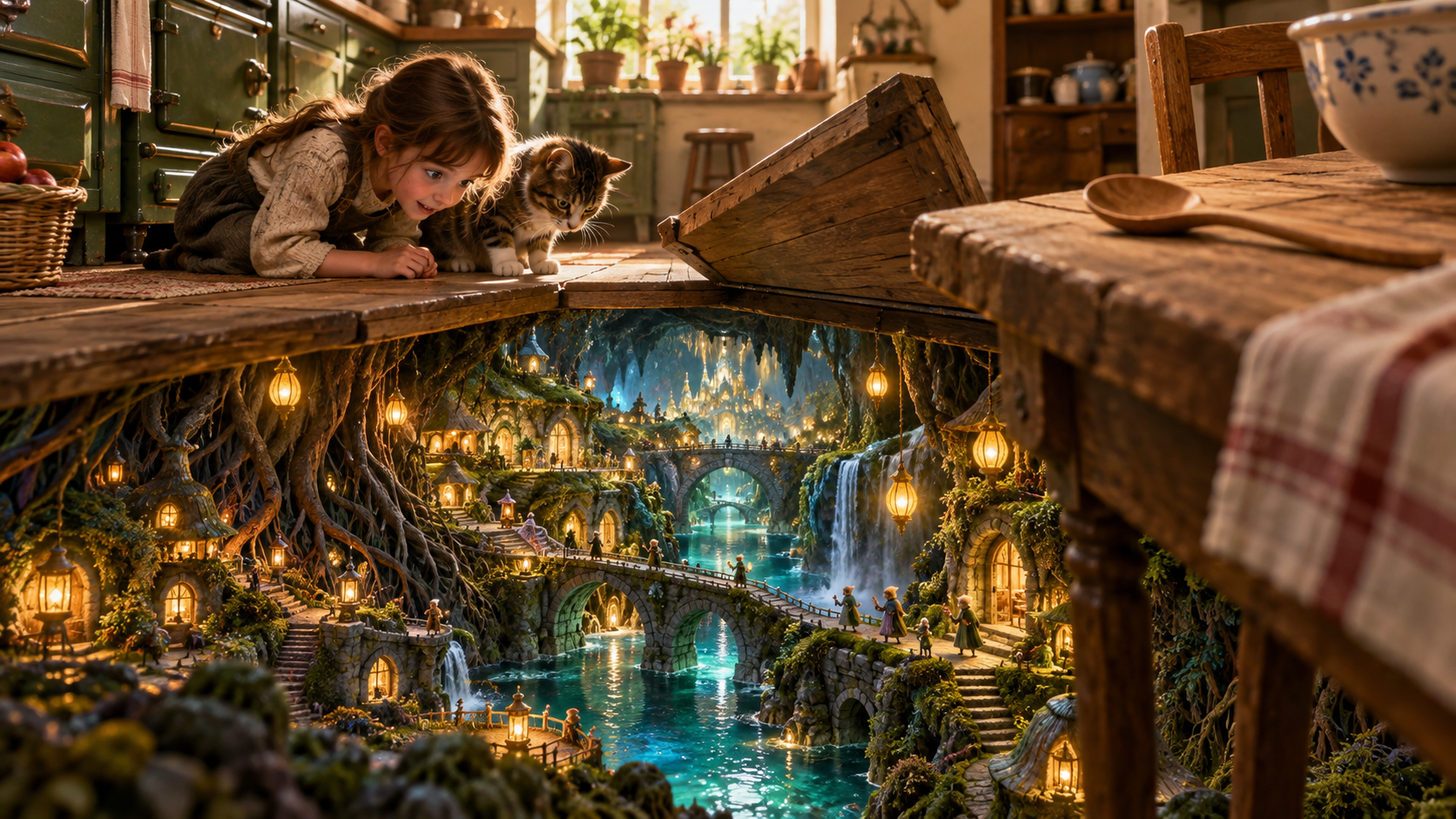
When Mara Bell inherited her grandmother’s house, everyone expected her to sell it before winter. The roof leaked above the back bedroom, the garden had gone to nettles, and the kitchen smelled permanently of cinnamon, ash, and the faint medicinal soap Gran had used in her last months. Mara had not lived there since she was seventeen. She remembered the house mostly as a place of rules: never slam the pantry door, never whistle after dark, never let the soup boil over. Yet the will left her everything, including a note folded into the recipe book: Keep the kitchen warm. It is not only ours. Mara assumed this was one more of Gran’s theatrical instructions. She lit the old range because the radiators had failed, made tea in a chipped blue pot, and planned to call an estate agent in the morning.
That night she woke to a sound beneath the stove: not mice, exactly, but the careful rhythm of many small hammers. When she knelt beside the cast-iron base, a thread of gold light appeared between two floorboards. The stone at the stove’s foot had always been loose. Gran used to press it with her heel before starting bread, a gesture Mara had copied without understanding. Now the stone lifted at Mara’s touch. Beneath it lay a narrow stair of blackened brick, descending farther than the house could possibly contain. Warm air rose from below, carrying rosemary, coal smoke, and the distant clatter of bells. Mara took Gran’s brass matchbox from the mantel, struck a match, and followed the stair down.
The stairs opened onto a kingdom no larger than the kitchen above. Its roofs were made from walnut shells, its roads from silvered teaspoons, its river from a slow spill of blue flame. Tiny people moved between shops built into cracked crockery. A woman in a thimble-shaped helmet stood in the square with a spear no longer than Mara’s finger. “The keeper has returned,” she said, though Mara had never seen her before. Behind her, dozens of faces looked up with the exhausted hope of people who had waited too long. The woman introduced herself as Captain Pella of Understove, a realm held together by the Bell family’s remembering. Every story spoken in the kitchen gave their lamps oil. Every name recalled at the table strengthened their walls.
Mara laughed once, because the alternative was admitting the impossible. Pella did not smile. She led Mara past a bakery where thumb-sized loaves rose in acorn cups, through an arch of bent forks, and into a hall whose ceiling was the underside of Gran’s stove. There, painted in soot and flour, were scenes from Mara’s family: her great-grandfather returning from the sea; her mother dancing barefoot on the tiles; Gran teaching Mara to crimp pies with a fork. The paintings flickered whenever Mara recognized them. Pella explained that Understove had begun generations ago, when an ancestor made a shelter for forgotten household spirits. In return, the spirits had guarded the family through lean years. But the bargain changed with time. The kingdom now survived not on gratitude, but on memory itself.
Gran had been its keeper for fifty years. She had remembered birthdays that nobody else did, repeated old jokes until the grandchildren groaned, and insisted every relative be named before Christmas pudding was served. Mara had thought it was sentimentality. Pella called it maintenance. “Your grandmother fed us stories when the family stopped feeding one another,” the captain said. “She knew every memory has weight.” The words made Mara think of Gran at the hospital, thin hands folded over a blanket, asking whether Mara still remembered the yellow bicycle with one broken pedal. Mara had said yes, impatiently, because she wanted to talk about something useful. Gran had nodded as if Mara had paid a debt.
The next morning, a builder named Colin Reeve arrived to inspect the house for the developer who had offered Mara a quick sale. The proposal was simple: demolish the kitchen wing, build three neat cottages, and leave Mara enough money to return to her city job. Colin pointed out rotten joists, outdated wiring, and the cracked hearth. Mara could not tell him that beneath the hearth lived a kingdom whose lamps had dimmed overnight. She only said she needed time. When his boots crossed the kitchen, Understove shuddered. Dust fell from the ceiling of its little hall, and one of the blue-flame bridges guttered out. Pella told Mara that demolition would not merely close an entrance. It would tear away the old foundation where the family’s memories had gathered.
Mara called her mother, Helen, hoping for an explanation. Helen went quiet at the mention of the kitchen. Then she said Gran had filled Mara’s head with nonsense and that the house had cost the family enough already. Mara’s uncle Stephen said much the same, though more gently: their mother had made every meal into a tribunal of who remembered what, who had visited, who had forgotten to call. Neither of them wanted the house saved. Mara heard years of resentment behind their voices, and she could not dismiss it as cruelty. Gran’s love had often arrived as insistence. She had kept records of absences as carefully as recipes. Still, when Mara asked whether they remembered the yellow bicycle, both answered at once. Neither could remember its color.
That evening, Pella showed Mara the Chamber of Hearthnames, where glass jars held bright scraps of memory. One contained Helen at twelve, hiding beneath the table while Gran distracted an angry neighbor. Another held Stephen learning to read from labels on spice tins. A third showed Mara’s father, who had died when she was small, carrying her through snow after her fever broke. Some jars were nearly empty, their labels fading. Pella said Gran had begun giving away her own memories to refill them. Each time the family forgot something precious, Gran surrendered a sharper piece of herself: the sound of her husband’s laugh, the face of her first friend, the name of the village where she was born. The kingdom lived, but Gran had begun disappearing long before her death.
Mara was furious, first at the kingdom and then at Gran for accepting its hunger. Pella said the bargain was never forced. A keeper could refuse, but then Understove would shrink, and the old protections would fail. “Your grandmother believed a family with no shared past becomes easy to divide,” Pella said. Mara looked at the small soldiers repairing a wall with crumbs of remembered songs and felt the cruel logic of it. She also saw its cost. Gran had not saved everyone; she had made herself the vessel that kept every fracture from showing. Mara decided she would not trade her own mind for a houseful of ghosts. But she also could not let Colin’s plans crush the people beneath the stove.
For three days Mara tried ordinary solutions. She asked the developer to preserve the hearth, then learned the plans required its removal. She invited Helen and Stephen for dinner, hoping that speaking together might brighten the jars. The meal began badly. Helen accused Gran of using memory as a weapon; Stephen admitted he had stopped visiting because every conversation became proof of his failure. Mara listened instead of defending the dead. Then she put Gran’s recipe book on the table and asked them to tell her one true thing the book had given them. Slowly, reluctantly, they did. Helen remembered learning to make plum jam after her first heartbreak. Stephen remembered Gran hiding a library fine in the flour tin. Their memories lit the kitchen windows, and beneath the stove, Pella later reported, three dark lamps had rekindled.
It was not enough. The developer shortened Mara’s decision deadline, and a storm damaged the kitchen roof. Water ran down the chimney into Understove, extinguishing the river of blue fire in two districts. Pella brought Mara to the lowest vault, where a black door stood under a sign reading THE GIFT OF THE KEEPER. Behind it lay a basin of clear water. One memory offered willingly, Pella said, could hold the kingdom through the winter and buy time for repairs. Mara understood the temptation immediately. She could give the first day at school, or her father’s hand in hers, or Gran’s face at the hospital. The basin promised relief without argument, without the slow work of asking people to remember one another.
She chose the morning Gran taught her to make bread. In the memory, flour covered the table, sunlight lay in squares on the floor, and Gran’s hands guided Mara’s clumsy fingers. Mara had loved that morning because Gran did not correct her. She only said that dough needed warmth, patience, and somewhere safe to rise. When Mara touched the basin, the scene brightened until it became almost unbearable. Understove blazed with sudden light. Water withdrew from the streets. But when Mara climbed back to the kitchen, she could no longer remember Gran’s voice. She knew the lesson had happened. She knew it mattered. The sound that had carried it was gone.
The loss did not feel noble. It felt like a theft Mara had consented to because she was frightened. Helen noticed first. Mara repeated a phrase Gran used to say, but without its rhythm, and Helen began to cry. She confessed that Gran’s last months had been full of gaps: she forgot names, then remembered everyone else’s childhood in painful detail. Helen had assumed illness alone had taken her. Mara told the truth about Understove, expecting disbelief. Instead Helen held the recipe book as if it were suddenly too heavy. Stephen arrived after midnight, skeptical but pale, and when the stair opened beneath the stove, he sat on the brick floor until Pella explained the bargain. “She gave herself to keep us from becoming strangers,” he said. “And we let her do it alone.”
Mara refused the basin the next time the lamps flickered. She told Pella that a kingdom built by consuming the people it protected had mistaken survival for care. Pella’s anger was quiet. Understove had never known another way. But the captain also admitted that the first shelter had been portable: a coal scuttle, a lantern, and a family willing to carry it. The stove was not sacred; the work of keeping a home was. Mara remembered Gran’s abandoned greenhouse behind the garden, its glass broken but its stone cellar dry. It stood outside the developer’s demolition line. If they could move the kingdom there, it might survive without demanding more memories from any one keeper.
Moving Understove took every person in the house. Helen sorted Gran’s recipe cards and read them aloud, not to prove devotion but to share what she knew. Stephen repaired the greenhouse door and carried bricks from the old pantry. Mara mapped the tiny streets on baking paper while Pella’s people packed their walnut roofs and spoon bridges into matchboxes. Neighbors came when Helen asked for help, bringing stories of Gran that Mara had never heard: a free pie left on a widow’s step, a winter coat mended at midnight, a kitchen table offered to anyone with nowhere else to sit. Those memories did not belong to the Bell family alone, and Pella discovered they could still feed the lamps when offered freely.
They worked through two cold nights. The old stair would not move, so Mara carried the first lantern down the garden path in both hands while the kingdom followed through a procession of sparks, beetles, and tiny bells. In the greenhouse cellar, Stephen laid the last hearthstone beside a small iron stove salvaged from the shed. Helen placed Gran’s blue teapot above it. When Mara lit the flame, the jars in the Chamber of Hearthnames did not vanish. Instead, their lids opened. Memories rose like warm breath and settled into new lamps, each one labeled not with a debt but with a choice: shared, kept, returned. The kingdom was smaller than before, and some streets had collapsed, but no one had been asked to disappear for it.
Colin returned a week later and found Mara with a preservation agreement for the greenhouse and a revised sale plan for the rest of the property. The developer could build cottages only beyond the garden wall, with the kitchen wing left standing until Mara decided its future. Colin said the arrangement was inconvenient. Mara agreed. So was inheritance. She did not keep the house because magic had made every hurt forgivable. She kept the kitchen long enough to repair its roof, gather the family’s records, and learn which of Gran’s rules had been love and which had been fear. Helen and Stephen came on Sundays, sometimes to cook and sometimes only to sit. They did not force stories from one another. They left room for silence that was not punishment.
In spring, Mara planted herbs outside the greenhouse cellar. Understove’s new market opened beneath the glass, where sunlight reached even the smallest roofs. Pella retired her cracked thimble helmet for a crown made from a bottle cap, which she said was more suitable for a kingdom that had survived a move. Mara still could not hear Gran’s voice in the bread lesson. That absence remained a wound, and she would not call it a fair price. But Helen remembered enough to describe the way Gran hummed when she kneaded. Stephen remembered the tune’s first three notes. Together they made something incomplete but living. Each time they spoke it, the lamps below gave a small, steady answer. The kingdom endured, not because one woman surrendered her past, but because many people chose to carry it with care.