The Witness Who Wrote Back
A letter signed by a dead woman asks Vera to reopen the case that ruined her family.
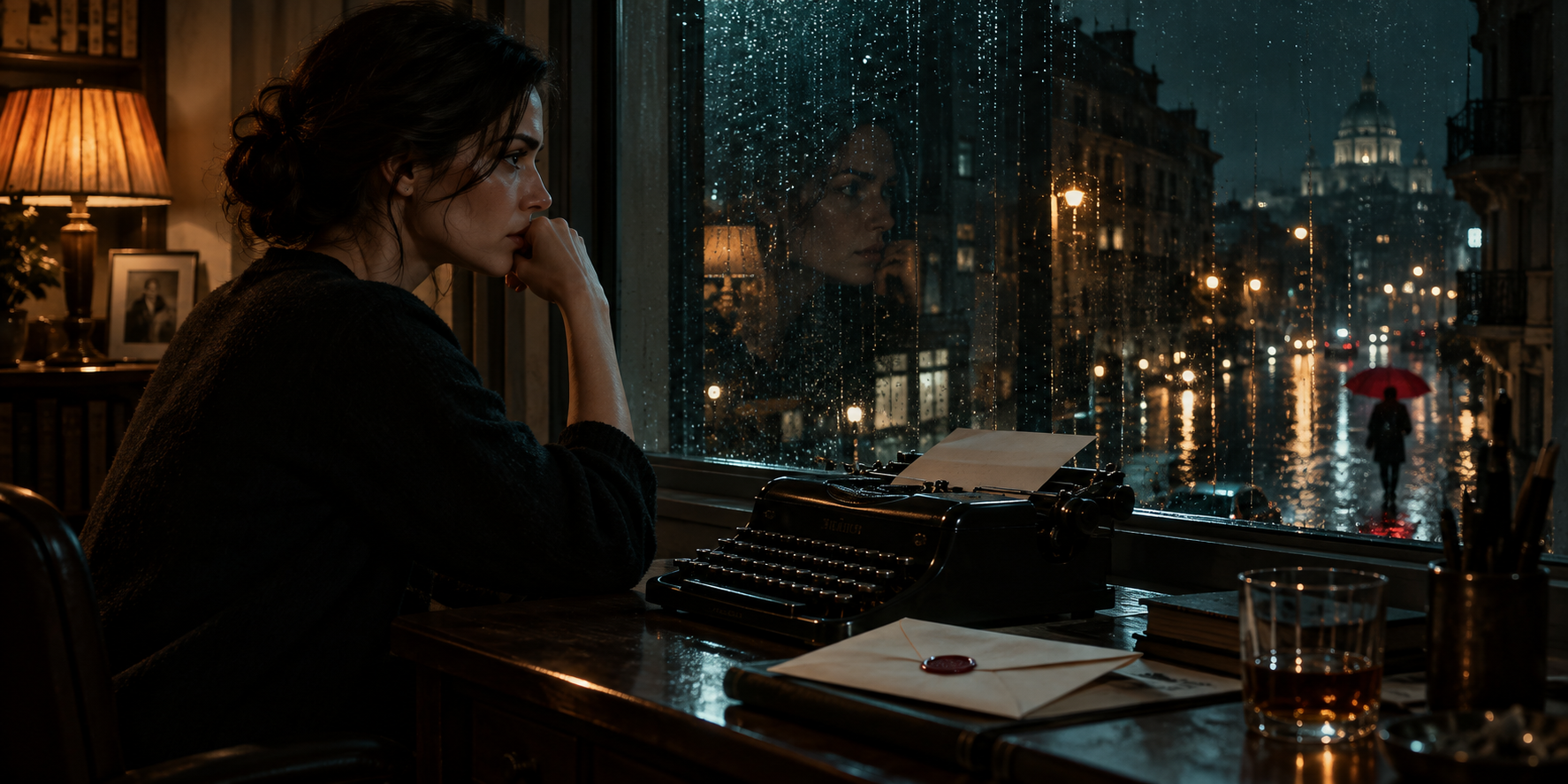
The letter arrived on the anniversary of Vera’s testimony, tucked behind a grocery flyer in the brass slot of her apartment door. Its seal was red wax. Its signature belonged to Celia Oran, the woman Vera had watched fall from the Marrow Hotel balcony twelve years earlier. Vera read it standing in the hall while her daughter, Mara, called from the kitchen about a school form. I am not asking you to save me, Celia had typed. I am asking you to tell the truth before he teaches your daughter to fear it. The sentence made Vera look at Mara’s backpack, then at the lock she had checked twice that morning.
Twelve years before, Vera had testified that Celia’s death was an accident. She had been nineteen, working the hotel’s evening desk, and she had said she heard a cry, saw the open balcony door, and found no one else in the room. Her father, the hotel manager, stood behind the prosecutor’s table with his hands folded so tightly his knuckles shone. Afterward he told Vera that silence had protected them. They moved to a smaller house, stopped answering old friends, and learned to call the loss of their home a practical decision. What remained was not safety but a family habit of swallowing questions before they became dangerous.
Inside Celia’s envelope was a heavy key stamped 614 and a card bearing only a date and the words, Keep the order. Vera almost threw both away. Instead, after Mara left for school, she went to the Marrow Hotel, now renovated with pale stone and a glass lobby that made its past look improbable. The clerk said the sixth floor was closed for repairs. Vera showed the key without explaining where it came from. It still opened the service stairwell, and the old lock at room 614 yielded as if it had been waiting.
The room had been stripped except for a typewriter on a table facing the rain-streaked window. A cloth covered it, but the keys were clean. In the desk drawer lay carbon copies of letters Celia had mailed to herself at a post-office box, each marked with a date and an instruction to open only if she failed to appear. The letters named Judge Alden Rook, then a rising prosecutor, and described meetings he held in hotel rooms with witnesses who had suddenly withdrawn statements. Rook did not need to threaten everyone in the same way. He mentioned a custody dispute to one woman, an immigration appointment to another, and a brother’s unpaid debt to a third. He made fear sound like private information.
One letter referred to Vera’s father by his first name. Celia wrote that he had hidden a guest-register page and a maintenance report after Rook told him the hotel would lose its license if he caused trouble. A separate note, unsigned, said that Rook had promised to destroy him and make sure Vera’s name followed the scandal. Vera sat on the bedspread, angry first at Rook and then at her father for being frightened enough to choose the lie. She wanted something simple: an arrest, a headline, a chance to watch Rook’s careful face break. But Celia’s last letter warned that revenge would give him another story to dismiss. Precision, it said, is what survives when powerful people call you emotional.
Vera took the papers home in a grocery bag. Her father was at the kitchen table when she arrived, older and smaller than the man who had once managed an entire hotel floor. He recognized the key before she spoke. He said room 614 had been used for meetings that never appeared on any schedule. When Vera asked why he had not told her the truth, he said he had believed Rook could make their lives unbearable. “He already had,” she answered. Mara, listening from the doorway, asked whether someone had hurt her grandfather. Vera told her not to record family arguments. Mara nodded, then said, quietly, “I don’t think this is only a family argument.”
Celia’s son, Tomas Oran, worked as a records clerk in the county archive. He met Vera reluctantly, with a stack of photocopies between them and the guarded patience of someone accustomed to strangers wanting a tragic version of his mother. He had received no letter. When Vera showed him the copies from 614, he compared their dates with settlement files he had noticed while indexing old court records. Several missing-person cases had been quietly resolved through a private foundation called the Rook Civic Trust. The payments were described as grief assistance, but the recipients had signed confidentiality clauses and their original case files had been sealed or misplaced.
They did not break into databases or invent evidence. Tomas requested the public filings he was allowed to retrieve, and Vera made a list of every name, date, hotel booking, and case number in Celia’s letters. The pattern was slow rather than dramatic: a witness changed a statement; a family accepted a settlement; a complaint disappeared from the docket. One former housekeeper agreed to speak only in a library parking lot. She remembered being sent to replace linens in 614 after midnight and seeing Rook leave with a man whose sleeve was torn. She refused to name him on camera, but she let Vera write down exactly what she had seen.
Mara began recording their conversations on an old phone, labeling each file with date, speaker, and whether the speaker had approved the recording. Vera objected until Mara showed her a notebook beside the phone: consent notes, file copies, and a list of things they still did not know. “If you only remember it in your head,” Mara said, “someone can say you changed it.” Vera heard the fear beneath the practical tone. She also heard something new: Mara was building an archive no one could quietly erase. They copied the recordings and scanned documents to more than one place, not to bait Rook, but so the truth would not depend on one frightened person keeping it alone.
Rook noticed the questions before the hearing was scheduled. A man in a dark coat waited outside Mara’s school one afternoon, then left when Vera approached. No threat was spoken, which made it harder to explain and easier to feel. Vera wanted to confront Rook at his chambers, to put Celia’s letter on his desk and demand an answer. Tomas stopped her. The record, he said, had to show what they could prove, not what they wished had happened. Her father, after two sleepless nights, signed a statement admitting he had hidden the register page and maintenance report. He did not ask Vera to forgive him. He only asked her to correct the sentence he had taught her to say.
At the hearing, Rook arrived in a dark suit with counsel beside him, composed enough to make Vera’s pulse feel like a personal failure. The room held former employees, families from the settlement files, and reporters who had not been invited twelve years earlier. Vera did not dramatize the balcony or claim to know every fact that had been buried. She described the room, the time, the open door, and then read the sentence she had lied about. “I saw a man leave the room.” The words were plain. They changed the shape of every silence that followed.
Tomas submitted the filing trail. The housekeeper gave her limited statement. Vera’s father described the threat that had made him hide evidence, without turning fear into an excuse. One by one, other people confirmed the small, precise pressures Rook had used: the phone call, the sealed complaint, the warning disguised as advice. Rook’s power had depended on each frightened person believing they were alone and that their particular shame made them unreliable. The hearing did not repair Celia’s death or promise every missing file would return. It made a record that could be checked, challenged, and answered.
Afterward, Vera returned to room 614 with Mara. The typewriter was still there, its ribbon faded but intact. Vera carried it home and put it in Mara’s room, not as a monument to fear or a demand that her daughter inherit the case. It was a tool with keys that required pressure and made every word visible. Before sleep, Mara rolled in a clean sheet of paper and typed one line, slowly enough for Vera to hear each strike: Dear future witness, you are allowed to answer.