The Orchard of Small Lies
When Lina inherits an orchard, its harvest ledger reveals the lie that made her family.
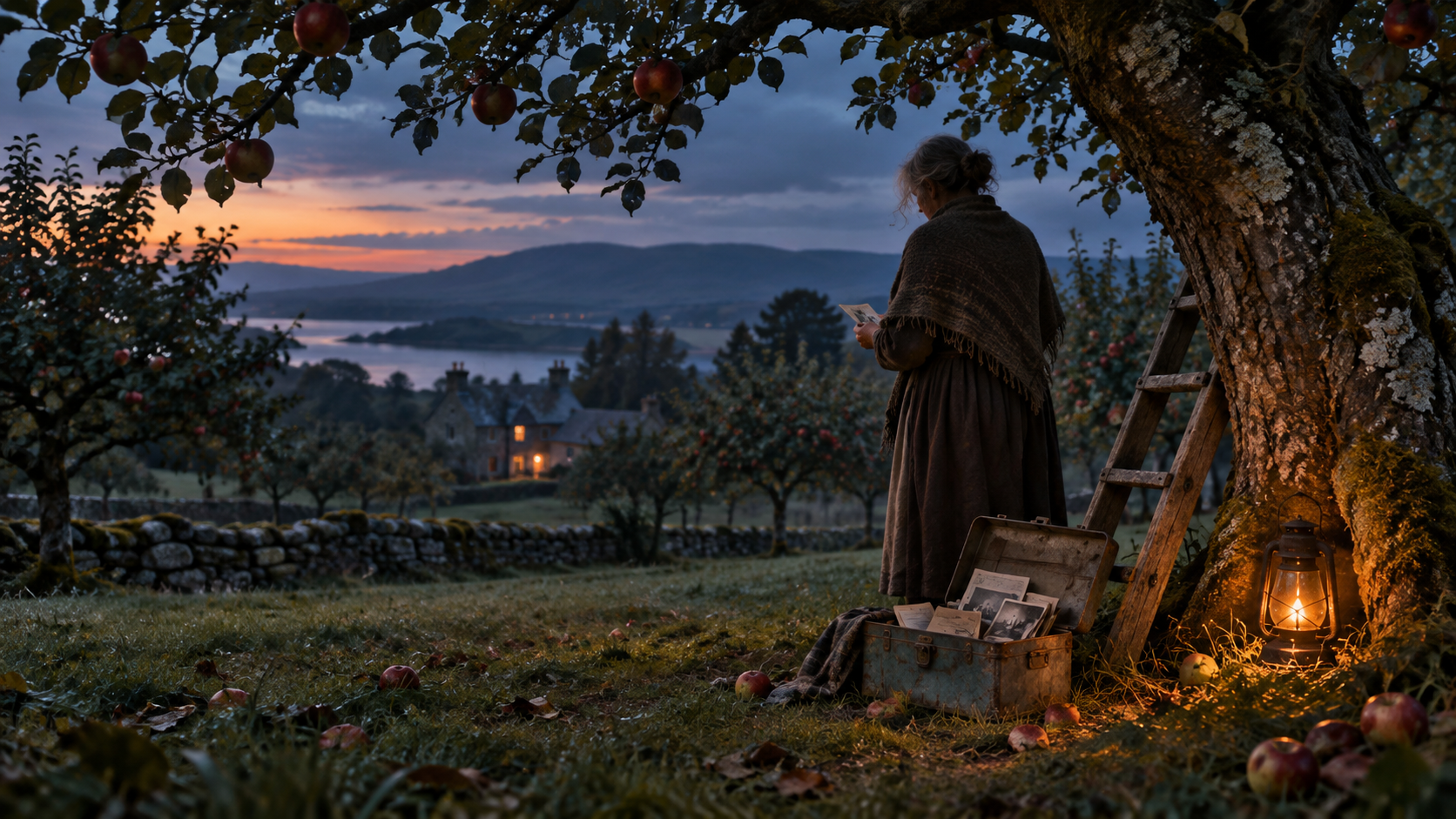
Lina returned to Bellweather for June's funeral with one suitcase and a plan to leave before the lilies at the church door browned. Death had made the town look arranged for her arrival. The diner sign still flickered on its tired blue wire. The church steps still smelled of wet limestone. Behind June's house, the orchard stood in its rows of old apple trees, each one leaning toward another as though they had spent years listening. The gate bell hung without a clapper, a detail Lina remembered only because June used to insist that every missing thing had a reason. June had left Lina the land, the house, the shed, and an envelope marked FOR THE FIRST PICKING. Lina expected an apology. The note held one sentence instead: Start with the tree that never bears fruit.
Everyone in Bellweather knew the tree at the far boundary. Its pale bark had split around a lightning scar, and its upper branches looked dead even in spring. Lina's father had called it the liar tree. It pretends to be dead so it won't be asked to give anything away, he used to say, laughing as if that made the name harmless. Yet he had never let Lina climb it. He died in a car accident when she was twelve. After the funeral June brought her to the orchard for one silent summer, then sent her back to Elaine in the city. No one explained why the orchard became a place they were supposed to remember but not discuss.
At the liar tree's roots, beneath a flat stone, Lina found a rusted biscuit tin. It contained twelve harvest ledgers, a photograph of a young June beside a dark-haired woman, and a birth certificate. The certificate named Ruth Vale as Lina's mother. Lina read it once, then again, waiting for the print to rearrange itself into a clerical mistake. Her mother was Elaine: Elaine with the grocery lists and vigilant questions, Elaine who had packed her lunches and sat awake through fevers in their narrow apartment three counties away. In June's handwriting, beneath the certificate, was the sentence that took the air from the morning: Elaine promised to keep you safe if Ruth could not.
Elaine did not deny it when Lina called. Ruth, she said, had been June's younger sister. Thirty years earlier, after a fire at the Vale packing house, Ruth had disappeared. Police called it an accident. The town called Ruth careless, then difficult, then simply gone. “I was twenty,” Elaine said, her voice so controlled that Lina could hear the work of control in it. “June put you in my arms and said the men who owned that place would rather erase a woman than answer for what happened.” Lina asked why she had been told another story. “Because every year,” Elaine said, “I found a new reason it was safer not to tell you.”
The ledgers made safety look like a second kind of handwriting. Every September showed crates delivered to the old packing house, then a smaller number written over the first in a different ink. June had circled those altered figures beside one name: Mercer. Lina remembered the Mercers as the orchard's prosperous neighbors, now owners of a winery with a polished tasting room and wedding photographs in the local paper. At the bottom of the tin lay a key tagged COLD ROOM 3. The abandoned packing house was full of weeds, shattered windows, and the stale sweetness of old apples. The key opened a locker containing invoices, wage slips, pesticide records, and a cassette labelled RUTH—IF I DON'T COME BACK.
June's old tape player still worked if Lina held the battery door shut. Ruth's voice emerged through static, young and furious rather than frightened. She described discovering that Owen Mercer had been changing pesticide records after workers grew ill. One woman had lost a pregnancy; other workers had gone home coughing blood into towels. Ruth had copied the books and intended to bring them to the county paper. She said Owen followed her into the cold room, locked the door, and left a faulty compressor running. “If they say I ran away,” Ruth said, “they are choosing a story over a person.” The recording ended with a bell ringing once, clear enough to make Lina look toward the open shed door.
Lina wanted the recording to become a clean answer: a villain named, a crime solved, and stolen years restored by an official voice. Instead she had a thirty-year-old tape, incomplete accounts, and a family that had survived by keeping its fear tidy. Mateo Alvarez, June's former orchard hand, remembered the ambulance and the Mercer men waiting near it. He remembered June taking a box from Ruth's room. He remembered Elaine, twenty and terrified, begging June to burn it. “Your mother was not lying because she liked the lie,” he told Lina. “She was afraid it was the only fence she could build around you.” Lina hated that a reason could be understandable without being enough.
That explanation did not make forgiveness easier. Lina spent a night beneath the liar tree, listening to wind move through branches that had outlived every adult who had made a decision for her. At dawn, she noticed a thin green shoot at the lightning scar. The tree had not been barren. June had cut away its flowering branches every spring, perhaps to make the name true, perhaps because a fruitless tree attracted fewer questions. Lina walked the rows and understood the orchard as an archive of choices: some made to protect, some made to profit, and some made because nobody believed a small lie could become a house large enough to live inside.
Elaine arrived two days later with a thermos, an overnight bag, and no request to be forgiven. She brought the few things she had kept: Ruth's hospital bracelet, a postcard June never mailed, and a photograph of Lina as a baby with Ruth's hand visible at the edge. They argued on the porch until neither could keep her voice level. Elaine admitted that protection had become habit, and habit had become cowardice. Lina admitted that the truth made every remembered kindness feel unstable. Elaine said she had loved her every day. Lina said love did not make concealment harmless. Neither statement cancelled the other. They agreed only that silence had already had enough time.
Together they went to the county archive and requested only records they were allowed to see. Lina copied dates from the ledgers. Elaine wrote down memories without improving them. Mateo gave a signed statement. A retired nurse confirmed treating packing-house workers for chemical exposure, though she could no longer name every patient. The newspaper that had ignored Ruth's call still kept an intake log. Ruth's name was there, beside an editor's pencil notation: verify source. The source had died before anyone verified her. The papers did not prove every detail on the tape, but they made the official accident story too thin to stand alone.
When they approached the present-day Mercer winery, its lawyer offered condolences, then asked whether they understood how damaging old accusations could be. Lina said she did. That was why she would not accuse anyone from a porch or make claims the evidence could not carry. She and Elaine gave archive copies to a labor reporter and to the county investigator. They marked what was documented, what was witnessed, and what remained unknown. Owen Mercer was dead, and no one promised a trial. But licensing records were reopened, former workers began finding one another, and Bellweather's preferred version of Ruth's disappearance stopped being the only version available in public.
The reporting produced no miraculous correction. Some neighbors defended the Mercer name. Others said they had always suspected something but had not wanted trouble. Lina learned that public truth could be slow, procedural, and disappointingly ordinary. It was still different from rumor, because it gave other people a place to add what they knew. When a former packer described the same chemical smell Ruth mentioned on the tape, Elaine wept in the courthouse parking lot. Lina stood beside her without touching her. After a long while she took Elaine's hand. It was not absolution. It was a decision not to make pain the only inheritance they could pass between them.
A week later, the county investigator called to say a sealed insurance file had been located. It did not settle Ruth's death, but it included a maintenance complaint about the cold-room compressor, filed days before the fire and signed by Owen Mercer. Lina felt no triumph when she heard it. The document did not return Ruth, and it did not tell her what June had endured while keeping the tin hidden. It did give the reporter another fact to print beside the testimony. For the first time, Lina saw Elaine breathe without immediately bracing for the next question.
They began sorting June's house slowly. In a kitchen drawer Lina found receipts for pruning tools and notes about the liar tree, all in June's impatient block letters. One read: CUT BLOSSOMS BEFORE THEY SHOW. Another, years later, read simply: NOT YET. Lina could not decide whether June had been protecting the secret or punishing herself for it. Mateo said June had believed that tending the orchard was the only honest work left to her. Lina did not accept that as forgiveness for June. Still, she let it complicate the anger. The dead did not become innocent because they were missed, but neither were they only the worst choice they had made.
In October, Lina pressed the orchard's first apples in years. The fruit from the liar tree was small, green, and sharply sweet. Elaine washed crates while Mateo tightened the old press, and June's photograph watched from the shed wall. Elaine said she had rehearsed the truth a thousand times but had never learned how to begin. Lina told her beginning late was not the same as beginning never. She could not offer absolution for every silence, and Elaine did not ask for it. They worked until their hands were sticky with juice and the afternoon smelled of crushed skins.
Before sunset, Lina opened the biscuit tin one final time. Under the cassette she found a new clapper June had wrapped in cloth. She fitted it into the gate bell, then stood back with Elaine. The sound crossed the rows of trees—plain, unpretty, and impossible to mistake for wind. The liar tree moved in the same breeze as every other tree, its new leaves flashing silver. Lina did not call it healed. Neither was she, and neither was Elaine. But the bell made room for a beginning, honest, necessary, and unfinished at last, and this time neither woman turned away from it.