The Map of Our Goodbyes
A map of every place they left each other sends two former friends back through the truth of one separation.
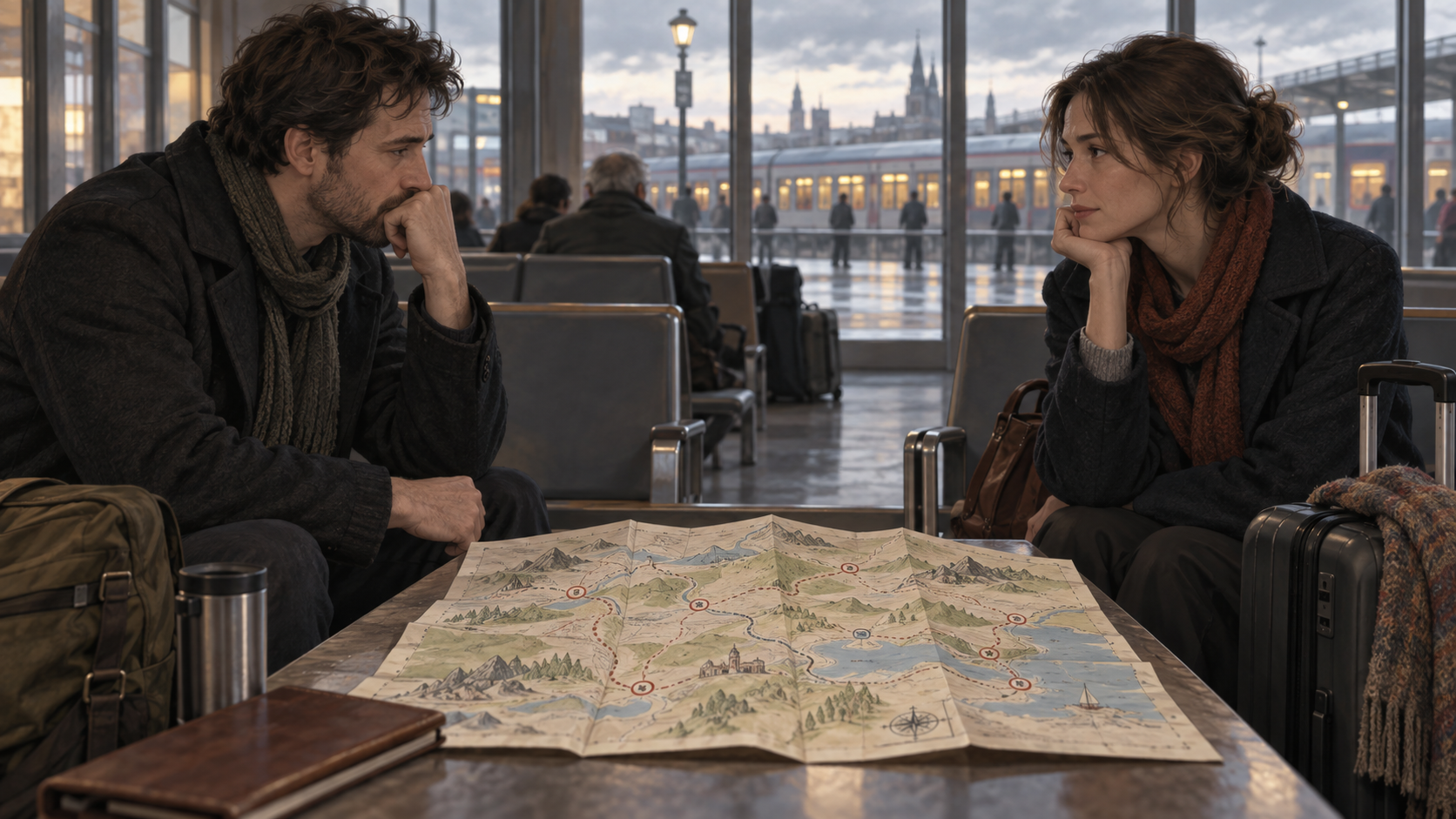
Nora Vale found the map in the sleeve of a used record at the Saturday market. It was a plan of Bellwether, faded at its folds and crowded with twelve colored pins. Beside each pin was a date in Daniel Reed’s careful hand: the train platform, the museum stair, the Juniper Café, the bridge where they watched a storm. At the bottom he had written, If you still think I left without saying goodbye, start at the first pin. Nora had not seen Daniel for six years.
They had met at nineteen during late shifts at the old cinema. Daniel repaired projectors; Nora sold tickets and wrote poems on discarded schedules. For years they were each other’s first call after family arguments, failed auditions, cheap dinners, and the quiet terror of choosing a future. Friends expected them to become a couple. They never did. Their intimacy was less tidy than romance and more dependable than most romances around them. That was why Daniel’s silence had hurt so exactly.
One week he was helping Nora pack for a fellowship in another city. The next, his number no longer worked. Nora took the map to the platform. A florist remembered Daniel buying yellow tulips there six years before and refusing to board a northbound train until someone came. She handed Nora a sealed envelope kept in a metal cashbox. Daniel wrote that his father had been taken to hospital and he had to leave for the coast. He had waited three hours.
A final sentence was crossed out so hard the page had torn: I am afraid you will think I am choosing him over you. Nora remembered the night differently. She had waited at Juniper, angry because Daniel was late, until her sister Liv called to say their mother had collapsed. Nora ran out without a note because she expected Daniel to understand. Days later his flat was empty. She told herself that someone who knew her so well would have found her.
The second pin led to the museum stair. A retired guard gave her a receipt Daniel had tucked into a brochure: two tickets, one unused. On its back Daniel said he had returned three months later hoping to explain, and had seen Nora with Elias. Nora laughed despite herself. Elias was her fellowship adviser, married and fifty years old; he had embraced her after telling her she was accepted. Daniel had written, I thought you chose a life with no room for the person who vanished.
At Juniper, Mrs. Han opened a tin of unclaimed things: spare keys, a child’s mitten, Daniel’s cassette recorder. It held a message he never delivered. His voice began apologies, stopped, and started again. In the final attempt he said he was ashamed to leave because his father was sick, and ashamed to be angry that his father needed him. He thought he had to return with a finished explanation before he deserved forgiveness. Nora listened in the empty café while Mrs. Han silently brought tea.
Daniel’s father had left his family when Daniel was a child and returned only when he needed care. Daniel usually turned that history into a controlled joke. Nora had mistaken restraint for strength. Now she saw that both of them had made a habit of not asking for what might be refused. She followed the next pins: the library where Daniel left a job application in her name, the rooftop garden where she told him about Liv, the pharmacy where he spent rent money on medicine.
None of the places supplied a villain or an excuse. They showed that their silence had been crowded with facts neither knew. The final pin sat on the old river bridge, dated the following Thursday. Nora considered not going. A map could be a way to control a conversation before it happened. But this map did not ask her to forgive Daniel. It asked her to arrive. She went with a notebook of questions and no rehearsed ending. Daniel waited by the railing, older and gray at the temples, holding two paper cups of tea.
He said his father had died two years after Daniel left Bellwether. He had worked in several towns because returning felt like entering a room after everyone had heard the secret. He made the map after coming back for a conference and seeing Nora’s poem in a bookshop window. He did not expect a reunion. He wanted to stop telling himself he had been abandoned by a person who had never been given a chance to answer. Nora said the same was true of her, and neither statement made the six years vanish.
Then Daniel named what the map could not soften. Before leaving, he had read a draft of Nora’s fellowship poem, about a friend who disappeared when life became difficult. He knew it predated the hospital call, but took it as an accusation. Nora never knew he read it. She admitted she had seen his father’s name on the hospital board that first week and had not gone inside. She was frightened and certain Daniel would reject her if she arrived too late. Their separation was not one person abandoning the other. It was two people mistaking fear for a verdict.
They did not turn the bridge into a stage for instant repair. Nora had a good life, Liv nearby, and work she loved. Daniel had a partner in another city, a kind man who knew the outline but not the exact wound. They talked about boundaries: no secret friendship, no midnight emergencies, no automatic claim on the other’s life because of the past. If they stayed in contact, it would be slowly, with consent from the lives they had built.
A month later Nora mailed Daniel a new map with only three pins: the bridge, the library, and a bench beside the cinema where they first met. She wrote: Said what happened. Asked what we did not know. No promise. Daniel sent a photograph of the map on his kitchen wall and a note saying he had told his partner the whole story. Nora did not mistake that for a return. It was a practice of honesty. She kept the map of their goodbyes because it finally showed that leaving and being left were never their only choices.
Over the next year, they exchanged occasional letters instead of trying to recover the daily closeness they had lost. Nora wrote that Liv had begun volunteering at the hospital; Daniel wrote that he and his partner had moved to a smaller flat with a room for family visits. Some letters went unanswered for weeks, and that was allowed. The map had not repaired their old bond or made its ending harmless. It gave them a more ordinary, harder gift: the ability to say when they were afraid, and to leave a door closed without pretending it had never existed.
When Nora passed the cinema, she no longer imagined a perfect sentence that could have saved them. She remembered instead that listening, arriving, and asking were choices that had to be made before certainty arrived. That knowledge did not make their history simple. It made the next conversation possible.