The Vow in the Ash Tree
A demolished house and a hidden promise force two former partners to decide whether love can survive the truth.
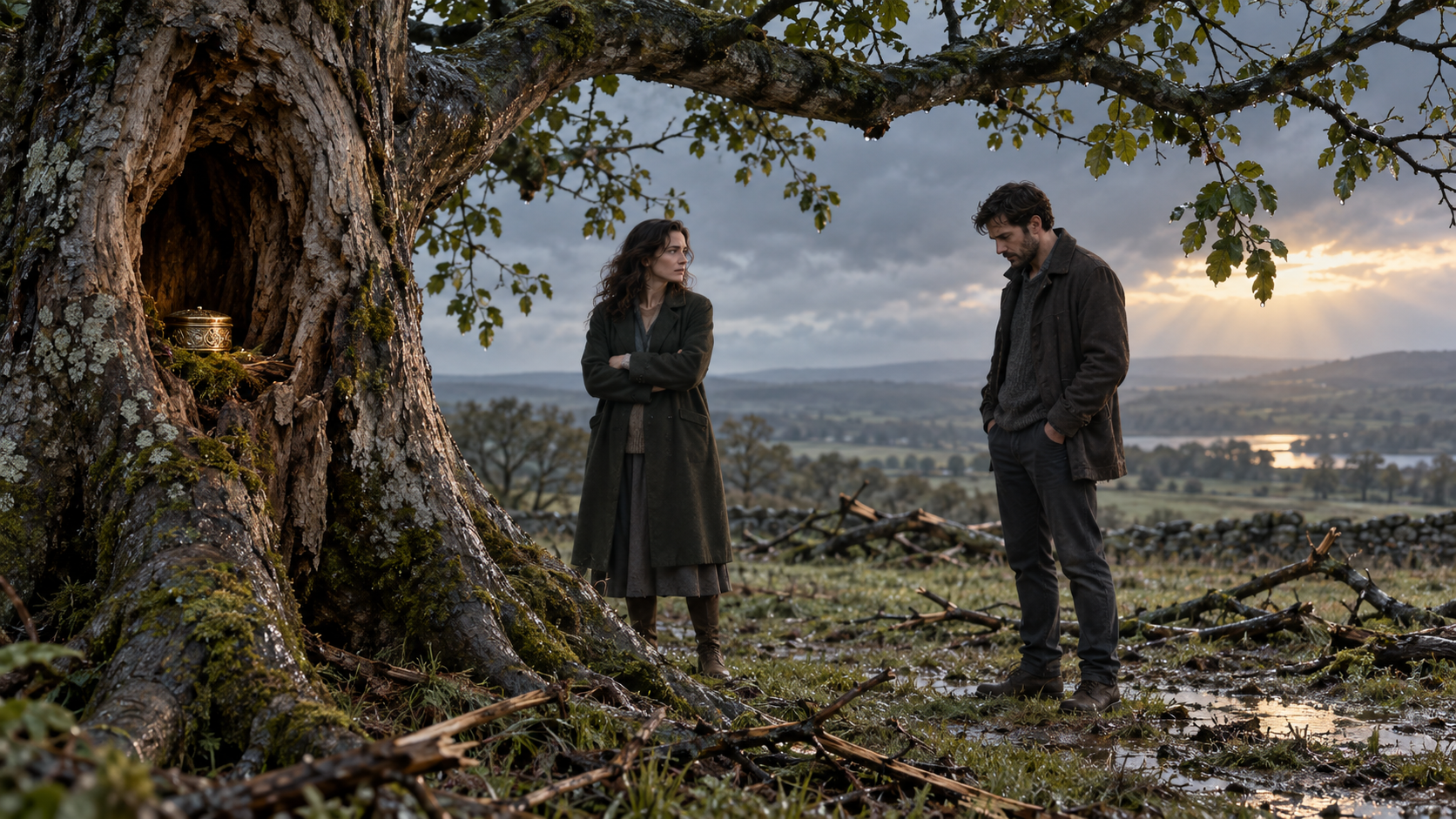
On the morning the demolition crew arrived, Elian Vale found Mara Sorrell standing beneath the ash tree with a hard hat in one hand and a sealed envelope in the other. Ten years earlier, they had promised each other beneath those branches that neither would leave without saying why. Then Mara had left their river town with no explanation beyond a note that said, I am sorry. The old Vale house was being cleared for a flood barrier, and Elian had told himself the tree was only wood, the house only a liability. Seeing Mara made every careful sentence feel like a lie.
Mara said she had come because the city had sent her as an architect for the barrier project, not because she expected forgiveness. Elian laughed once, without warmth. He ran the small repair shop across the street, had spent years watching the house sag and refusing every offer to buy it. When the foreman asked whether the site was safe to begin, Mara asked for one hour. “There is something in the tree,” she said. Elian remembered the vow they had made by cutting their initials into a loose strip of bark, then pushing a brass tube into the hollow behind it.
The tube was still there, green with age. Inside lay two copies of their vow, written in the impatient handwriting of twenty-year-olds: We will tell the truth before fear tells it for us. Beside the papers was a letter in Elian's mother Rosa's hand. Rosa had died three years before, and Elian recognized the old woman’s precise loops before he could read them. The letter said that Mara had not abandoned him for ambition or boredom. She had left because Rosa had asked her to, after discovering that the company owned by Elian’s father had concealed soil reports beneath the house.
The reports described a leaking chemical store on the land behind the garden. Rosa believed that, if Elian knew, he would confront his father, lose the shop’s financing, and be pulled into the investigation. Mara had agreed to leave while Rosa collected evidence. But Rosa’s illness accelerated; the evidence remained in a locked cabinet, and the only message she managed to send Mara was a warning to stay away. Elian felt the old betrayal rearrange itself without becoming smaller. Mara had kept a secret to protect him, precisely the thing their vow had forbidden.
Mara did not ask him to excuse her. She explained that she had returned twice and seen Elian’s father waiting outside the repair shop. Once, a man from the company told her that accidents happened to people who confused private history with public records. She had believed distance was the safer answer. “I did not trust you with danger,” she said. “That was not love. It was fear wearing love’s coat.” Elian wanted to say she had made herself the only brave person in the story. Instead he asked where the cabinet was.
They found it in the pantry behind a false panel, protected from damp by jars of old preserves. There were reports, invoices, photographs, and Rosa’s timeline of calls to inspectors. The material did not prove every intention, but it showed that the company had known the ground was contaminated before it renewed the house’s insurance and before it pressured tenants to leave. Mara photographed nothing until the city’s records officer arrived. Elian watched her insist on a chain of custody and understood that she had not returned for a dramatic reunion. She had returned because the barrier excavation could expose the leak to the river.
The city halted the demolition. Elian’s father, Corvin Vale, arrived in a black car and called the documents family misunderstandings. He told Elian that Rosa had been fragile, Mara had been manipulative, and the project would bring jobs. Elian heard the old reflex in himself: make peace, lower his voice, let a stronger person decide what facts were allowed in the room. Then he placed Rosa’s letter on the kitchen table and said that no one would remove anything until independent inspectors had reviewed it. Corvin left without shouting. His restraint frightened Elian more than anger would have.
For two weeks, Mara and Elian worked in the house during daylight while inspectors sampled the soil. They spoke about practical things first: drainage maps, the cost of replacing a bent hinge, which café still made terrible coffee. At night, the unfinished conversation returned. Elian admitted he had read Mara’s farewell note until the paper tore at the folds. Mara admitted she had kept drafting explanations because each one sounded like an excuse. Neither used the new evidence to erase the harm of silence. They could name the pressure around them and still name the choice they had made inside it.
The inspectors confirmed contamination and found that the proposed barrier design needed to change. The company was ordered to fund cleanup while the city opened a public inquiry. No one promised a criminal verdict; records were old, and several decision-makers were dead. But the riverbank was protected, tenants were offered relocation support, and Rosa’s documents became part of the public file rather than another family relic hidden behind plaster. Elian testified about what he knew and what he did not. Mara testified about the threats she had received. They refused to turn either account into a grander certainty than the evidence held.
On the day the ash tree was scheduled to be removed, the arborist found its roots were outside the excavation line. The new plan could keep it. Elian almost asked the city to cut it down anyway. The tree had held too much: a promise, a lie, his mother’s last attempt to repair both. Mara said keeping it did not mean preserving the old story. They cleaned the brass tube, replaced the rotted strip of bark with a small plaque, and agreed the words on it would not be their old vow. A vow, Elian said, was useless if it demanded courage only from the other person.
They wrote a new sentence together: Tell the truth early; ask for help before fear makes the choice. It was less romantic and more difficult. Mara asked whether there was room in his life for a person who had failed him. Elian said there might be, but it could not be a room she entered as though nothing had happened. She nodded. They began with coffee after the inquiry meetings, then with walks along the river once the temporary fences came down. Their closeness returned in fragments, not as a reward for suffering but as a practice that required an answer each day.
In spring, the clean soil was planted with reeds and wild iris. The repair shop stayed open; Mara joined the city’s independent design panel and refused work from Corvin’s company. Beneath the ash tree, children from the neighborhood hung paper wishes during the river festival. Elian and Mara stood apart at first, then close enough that their sleeves touched. Neither promised forever. They had learned that a future could not be secured by hiding its dangers. But when Mara said she was leaving for a three-day site visit and asked if he wanted to know why, Elian smiled. “Yes,” he said. “And I will ask when I’m afraid.” The tree moved above them, holding no secret except the one they had chosen to share.