Seven Keys for Sunday
Every Sunday, Mara finds another key in her late mother’s kitchen. Each one opens a family secret—and the last one asks whom she is willing to forgive.
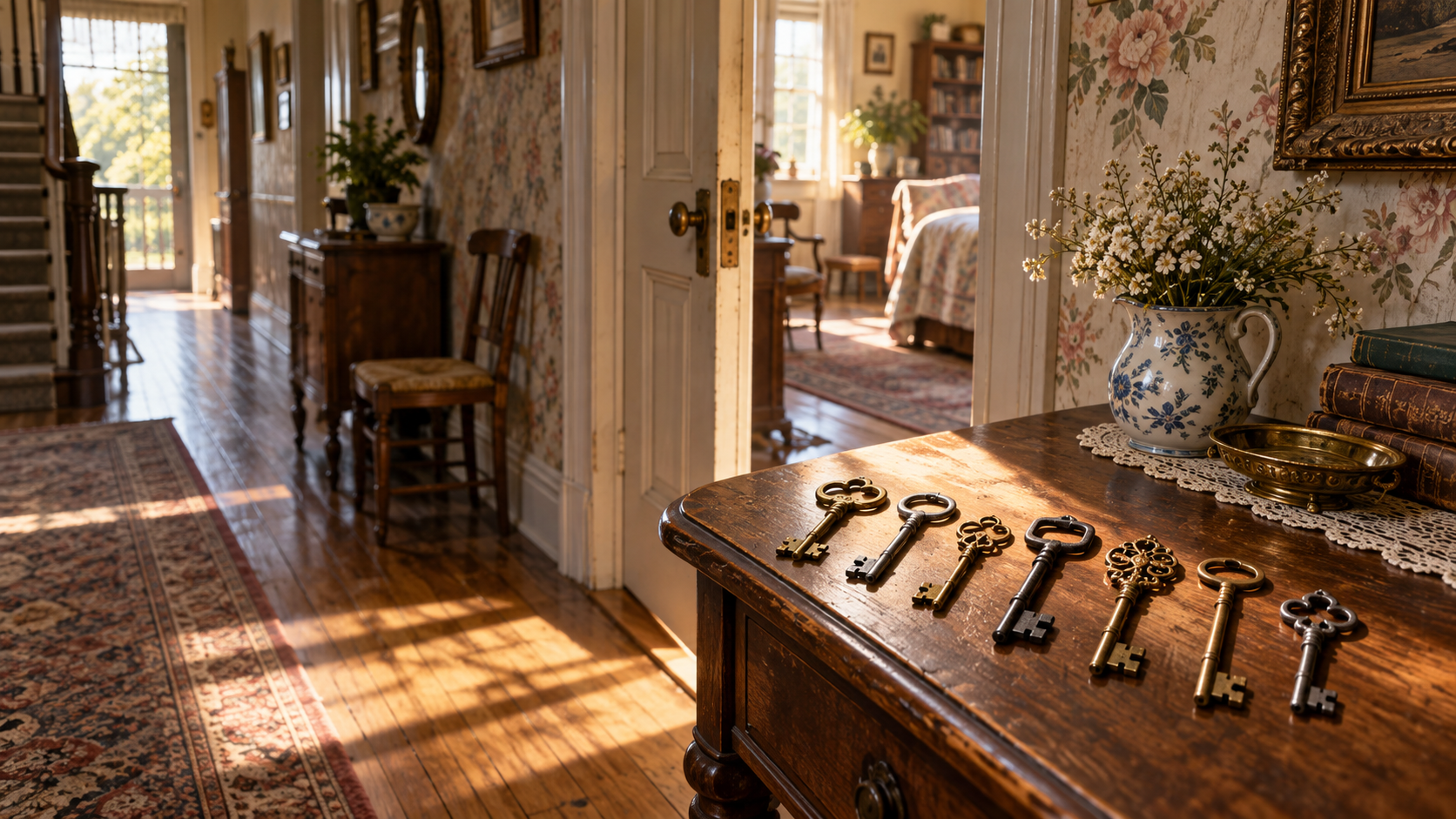
On the first Sunday after her mother’s funeral, Mara Vale found a brass key in the sugar bowl. It was tied to a tag in her mother Iris’s exacting hand: PANTRY, 1989. Mara lived in the little house now, though it still smelled of Iris’s lemon polish and rain-damp coats. Her brother Daniel had taken the train back to the city, saying the house could wait until grief had become a practical problem. Mara tried the key in the locked pantry door. Inside, behind flour tins, sat a cassette recorder and one tape labelled: FOR MARA, WHEN YOU ARE OLD ENOUGH TO BE ANGRY.
The recording contained Iris at thirty, laughing once before her voice changed. “Your father did not leave us,” she said. “I told everyone he did because I did not know how to keep you safe and tell the truth at the same time.” Mara stopped the tape. Her father, Elias, had supposedly abandoned them when she was six. Iris had made the story into family weather: regrettable, permanent, never questioned. The tape ended with a date and no explanation. Mara called Daniel, who said their mother had been sick, not unreliable. Then he asked whether she had found a key too.
The next Sunday a key lay beneath the church bulletin, although Mara had not gone to church. Its tag read DESK, 1994. The desk drawer held a pile of unopened letters addressed to Elias Vale at an address in Northbridge. The earliest was from Iris. She wrote that he could not see the children until he stopped frightening them with his temper. The later letters were never sent. Between them was a court notice: Elias had requested contact; Iris had withdrawn her claim for a protective order two years later. Mara read it three times. Her father had not simply vanished, and her mother had not simply lied. Something had broken between those facts.
Daniel arrived that evening furious that Mara had opened private papers. He remembered their father shouting, a broken plate, Iris holding both children behind the bathroom door. He also remembered a man who braided Mara’s hair badly and invented games on rainy days. “You want a villain who makes the story tidy,” Daniel said. “Mum wanted one too.” Mara answered that a child deserved more than a tidy lie. Neither of them knew whether anger at Elias excused Iris from deciding, alone, what their memories would be allowed to mean.
Sunday brought a third key from inside the bread tin: CLINIC, 1997. It opened a metal cashbox in the attic. There Mara found appointment cards from a family counsellor, Dr. Lin, and a letter Iris had written but not posted. Elias had entered a treatment program after the night of the broken plate. Dr. Lin’s summary said he attended, relapsed once, then completed the program; it also said Iris had every right to refuse reconciliation. But a handwritten note on the margin stunned Mara: “Elias has asked for supervised letters. Iris says Daniel must never know he asked.” The past was not a courtroom with one verdict. It was a room in which adults had made frightened choices and then hidden the keys.
Mara went to Northbridge alone. Elias lived above a bicycle repair shop, thinner than memory and careful with every word. He did not ask to be forgiven. He said he had been dangerous that night, and that Iris had been right to take the children away. He had written for years because Dr. Lin told him repair meant accepting an answer that might never arrive. When Mara showed him the unsent letters, he cried without defending himself. “I thought she threw mine away,” he said. “I told myself it was the price. Then I told myself so often I stopped trying to know anything else.”
The fourth key appeared in a jar of buttons, tagged BANK, 2002. Its lockbox contained deposit slips and an account in Daniel’s name. Iris had been sending small sums to him while he was at university, money marked as help from an anonymous scholarship. At the bottom was a receipt from a woman named Ruth Calder. Ruth had paid Iris each month to keep a promise: no contact between Elias and the children until Daniel finished school. Mara understood at last why the dates had gaps. Ruth was Elias’s sister, and she had feared his relapse as much as Iris did. The arrangement had begun as protection and hardened, year by year, into silence that paid for itself.
Daniel refused to meet Elias. He said a secret fund did not make their mother cruel; it proved she had carried them alone. Mara agreed, but the agreement did not answer the questions. Why had Iris hidden the counselling record after Elias was sober? Why had Ruth paid instead of insisting on a legal plan? Mara wrote to Dr. Lin, expecting nothing. The retired counsellor replied that confidentiality prevented details, but confirmed that Iris had cancelled a supervised meeting after Daniel panicked at a school play. “She believed delay was kindness,” Dr. Lin wrote. “Delay can become a decision before anyone admits it.”
The fifth key came from the freezer in a small envelope: SUNDAY ROOM, 2007. It opened the door of a disused community hall where Iris had volunteered. In a cabinet Mara found a notebook of Sunday visits. Iris had met Elias there twelve times over two years, alone. She recorded his work, his sobriety checks, and the questions she could not ask aloud. On the last page: “He is better. I am still afraid. If I let him back, I betray the children; if I keep him out, I may teach them fear is the only inheritance.” Mara sat on the dusty floor until the caretaker switched on the lights. Her mother had not possessed certainty. She had possessed responsibility without relief.
The sixth key was tucked into Iris’s recipe book on the Sunday marked with Mara’s twelfth birthday. It opened a blue suitcase under the guest bed. Inside was a bundle of Elias’s letters, all of them opened, all of them answered in drafts Iris never mailed. The final draft said she would let Mara choose when she was eighteen. It was dated two days before Iris received a diagnosis that required surgery. In the margin she had written, “If I die, Daniel will be angry. Mara will try to understand. I must not make either child carry my unfinished courage.” Yet she had made them carry it anyway, in different forms.
The seventh key did not arrive on Sunday. It was already on Mara’s key ring, an ordinary front-door key Iris had given her years earlier. On its back, newly visible where the metal had worn, was a tiny stamp: E. VALE. Mara realised the sequence had not been a treasure hunt. Iris had left the keys in places she expected Mara to keep using, so that discovery would come slowly enough to hurt without becoming spectacle. In the kitchen drawer she found a final envelope. It held no confession, only a request: “Tell Daniel I was frightened. Tell Elias I was sorry. Tell yourself that understanding me does not require excusing me.”
Mara invited Daniel and Elias to the community hall, not the house. She brought copies of the documents and Dr. Lin’s short letter, not a script for reconciliation. Daniel said he could not call Elias Dad. Elias said he would not ask him to. Mara said their mother had protected them, harmed them, loved them, and lied to them; all four sentences could be true. No one embraced. Daniel asked Elias one question about the broken plate, then another about the years afterward. Elias answered without asking for credit. When the hall closed, Daniel took the blue suitcase but left the money records with Mara.
The following Sunday Mara made tea in Iris’s kitchen and put the seven keys in a glass bowl, not back into their hiding places. Daniel came late with bread. He said he had booked a therapist, not because their mother had failed but because secrets had. Mara told him Elias had sent no message. That restraint felt like a beginning rather than a punishment. The house remained full of its old habits, but its doors no longer dictated the story. Mara locked the pantry and kept the key in plain sight. Some family mysteries ended with an answer. This one ended with people choosing what to do after the answer.